

Whose Father?
Exploring the Lord's Prayer and what it means for us.

The idea of a Father can conjure up warm feelings of comfort, safety, and joy for many people, but for others, it can trigger past traumas, anger or even ambivalence. I suspect that the meaning and role of “Father” in contemporary society have changed substantially since the time of Jesus. In this post, I am exploring the ideas of dis/ability, the church, and what it means to call God, “Father,”. It is one of a series of posts, working through “The Lord’s Prayer” from a marginal perspective.
Our Father, who art in heaven,
hallowed be thy name;
thy kingdom come;
thy will be done;
on earth as it is in heaven.
Give us this day our daily bread.
And forgive us our trespasses,
as we forgive those who trespass against us.
And lead us not into temptation;
but deliver us from evil.
For thine is the kingdom,
the power and the glory,
for ever and ever.

Amen.
So let’s begin with what it means to call God, “Our Father”. Jesus, who taught us this prayer in the book of Matthew, is the Son of God. And we are told many times in scripture, including 1 John 3, that we have been adopted as God’s children. It says,
See what kind of love the Father has given to us, that we should be called children of God; and so we are. The reason why the world does not know us is that it did not know him. 2 Beloved, we are God's children now, and what we will be has not yet appeared; but we know that when he appears we shall be like him, because we shall see him as he is.
There are three important implications of God as Father that I want to point out.
First, we have been adopted as children of God, and he loves us. As my pastor pointed out on Sunday, God could have just forgiven us of our sins, but instead, he chose to adopt us as sons and daughters. This relation is one of deep connection and belonging. During biblical times, when a family wanted to adopt a child, they looked for someone worthy of carrying on the family name, perhaps a child with good teeth, tall stature, or strong muscles. God, however, isn’t concerned with what the world values; he looks at the heart, which means that, even if you don’t see yourself as worthy, perhaps even broken, God sees his child.
We live in a culture where less-than-perfect is dispensable. We take tests during pregnancy to ensure perfection, and when a fetus is less than perfect, many medical professionals will encourage the parent(s) to dispose of it. Similarly, when a person is past their prime (which is not necessarily in senior years), they are often encouraged to take the “out” and end their life through medically assisted death.
But where society sees defect, God sees beauty. Where culture sees a liability, God sees a gift.
Second, because God is our father, there is a familial connection. I have heard it said that if you want to know how to treat a child with a dis/ability, look at how their siblings treat them. Most often, we do not kick people out of our family because they do not live up to the standard - instead, the standard changes. I am not going to abandon Ella because she does not get the same grades in school as her brother, and I am not going to kick Ella’s brother out of the family because he doesn’t put his clothes away when I ask him to (which Ella is a rockstar at). Into adulthood, however, this is another area where societal narratives are in contrast. We are told that if a person hinders us in any way from being our true individual and independent selves, we should cut them off, including family (especially family?). But we were not created for independence, we were created for interdependence. Family is family is family, and the Church is the family of God, so why do we act like one part is not important or kick other parts out if they don’t produce enough, volunteer enough or participate enough? We are part of God’s family: he is our heavenly Father, and we can find belonging in his family.
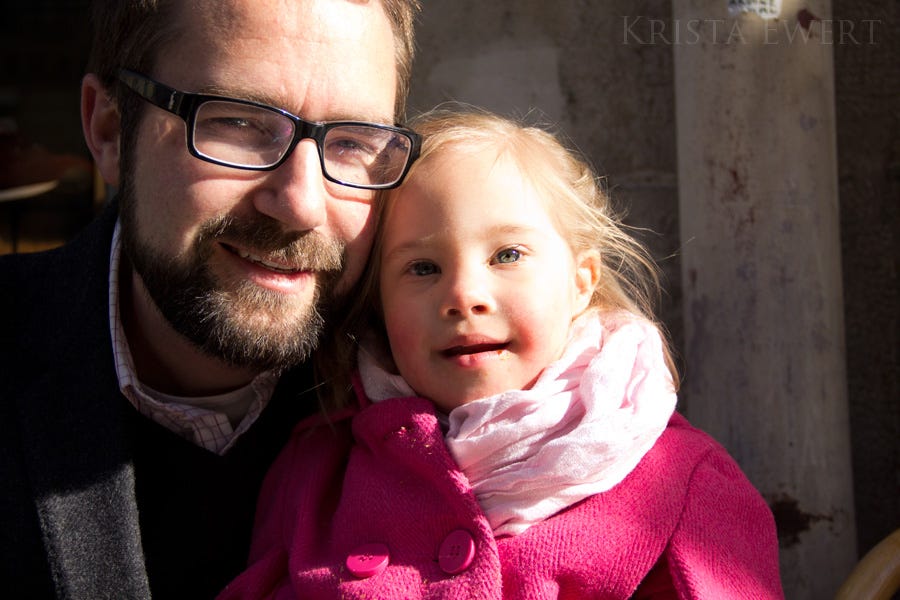
Historically, fathers have been the head of the household. They were responsible for protecting their family, being spiritual leaders, holding the wealth and managing the household. While our earthly fathers don’t always epitomize these qualities, our perfect heavenly Father is all that a father and mother were created to be. A father takes joy in their children and cares for them so deeply, just like God cares for us.
Third, we shall be like him. “But we know that when he appears we shall be like him, because we shall see him as he is.” We will see him as he is, and he, it turns out, is like us or I should say, we are like him. I have written before about the idea of Imago Dei. We are made in the image of God - not just the fittest of us, or the smartest, or the most productive, but all of us and at all times. We are not just in the image of God when we are at our physical prime, but when we are infants and in our last years. I think a key line in this verse is, “we shall see him as he is.” It makes me wonder if we don’t in fact, see him as he is but we make up an image in our mind of God that makes us feel comfortable. There is a book called The Disabled God. In it, the author, Nancy Eisland, explains a vision she had of God in a sip-puff wheelchair. I’m not saying that God uses a wheelchair, but the point is that God might not be what society has conditioned us to believe a god should be. Just look at Jesus. He didn’t exactly fit the worldly “messiah” archetype. We can’t know fully what God is like in this life, but we can know that we are made in his image and he takes joy in each person he has created.
Since I never had a relationship with my earthly father, having God as my father is a darn good deal.