

From: Failure to Thrive (pt. 1)
Part one of the story of Ella in a summer camp discipleship program

Well, that’s it, friends.
Another summer is coming to an end. I know, someone had to say it.
I have had a few new subscribers join over the summer, so I just want to say, Welcome!
I hope you will find this space encouraging and challenging all at the same time.
Soon, we will be back to regular programming, but I wanted to take some time to reflect on some of the big thoughts and lessons learned in the recent months.
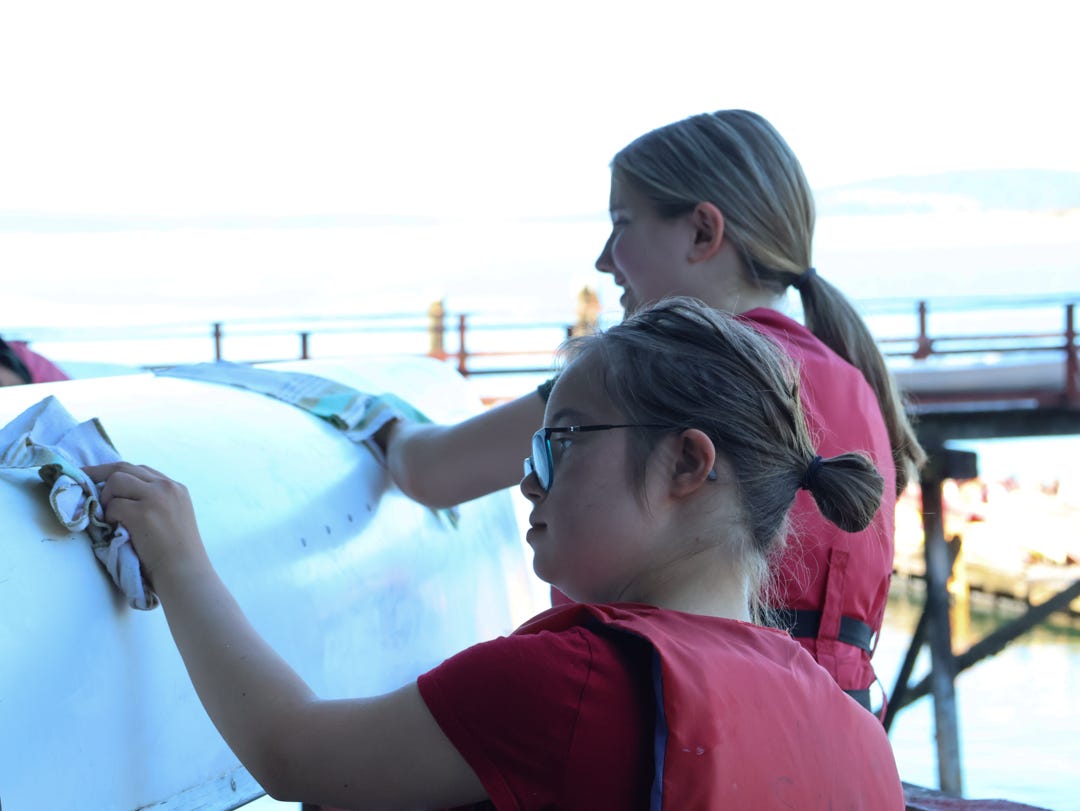
As we have done every summer since moving back from the UK, we spent a couple of weeks at a Pioneer Pacific Camp on Thetis Island. The first week was Family Camp, at which Ben (my husband) and I spoke on The Lord’s Prayer — I am excited to share more with you as I continue the little series I started before the summer break. The second week, Ben returned to work while the rest of us stayed in our various capacities. Jakob, our oldest, had already been at camp since the beginning of summer, working as the photographer and social media manager. Ella participated in one of Pioneer’s youth discipleship programs called Pioneer Youth Crew (PYC), Audrey was a camper for the first time, and I helped out with programming.
There is so much rich experience that comes from being at camp – the front lines of ministry in which we have the privilege of speaking into the lives of the next generation – but I want to focus today on Ella’s experience. Let’s just say that PYC has never had an Ella (an individual with a developmental dis/ability and the two weeks she was there were a huge learning experience that exposed how an organization can rethink in light of kingdom praxis – if we are the body of Christ made up of persons of all dis/abilties, what does it look like to make our programs places of belonging for everyone?
I had pitched the idea of Ella participating in PYC a couple of years back to the camp director, and he was totally on board. This past year, however, brought some big leadership changes at the camp, and new directors were hired. And while they didn’t know us, we didn’t know them, and they didn’t yet love Ella, they were very open and receptive to the idea. Pioneer is an example of soft ground – very open and willing, but not really sure where to start. We had talked over lunch one day in the spring about what Ella might need to succeed in PYC, but that was about it. We planned to take it week by week and hold it all with an open hand.
The default for many programs is to have one-on-one support because the thought is that it will mitigate any risk or programming challenges. In other words, if we have one-on-one support, we don’t need to adapt or change our programming. While we expressed that Ella doesn’t necessarily need one-on-one support all the time and that programmatic changes may benefit everyone, this is where it was left.
When we arrived at camp, I took no more than half an hour to speak with the PYC leaders and gave them a quick run-down on Ella and what success could look like. I explained our big picture vision for the group to become a supportive community for all, the details of personal hygiene and everything in between. While all the leaders were part of that meeting, there was one leader who was brought into the PYC program to be Ella’s primary support.
Let me take a minute to explain the PYC program. PYC is an intense three-week discipleship program that has a rigorous schedule starting with a morning dip at 7 am (3 minutes to get up and dressed in your bathing suit: last out of the house is first into the frigid Pacific Ocean) going until at least 10 pm after a day full of doing dishes, cleaning bathrooms, bible study, and of course, some fun. I love PYC, and my son thrived in it. It builds character, friendships, and faith; however, there is a certain type of individual who naturally thrives in a program like PYC, and it isn’t exactly Ella. The goal is to shift the program so that persons of all dis/abilities can also thrive.
While we could send Ella to an Easter Seals camp or a camp like Zajac’s Ranch (both awesome programs designed specifically for persons with dis/abilities), we want Ella to be a part of our Christian community. We don’t want her to feel like she can only belong with other individuals with dis/abilities. We also don’t believe it is a biblical vision for the kingdom of God.
So, back to Ella in PYC without writing a whole dissertation. How did it go?
The first few days were a bit rough for Ella and her support person, as they are for everyone in PYC. It was a new group of kids, a new schedule in a new environment with new expectations. The group was learning how to be a group, and Ella’s support person was learning how to be a support. Wednesday night, however, brought a pivotal change that exposed the cracks of a fragile situation. I think there were three fundamental reasons why Ella, the support person, and the group were failing to thrive.
Failure to see Ella as a full member of the group
I have heard Disability ministry compared to an expansion pack to a strategy game (i.e. Seafarers of Catan). The reality, however, is that the game needs to change altogether. Ella was seen as an addendum. In those first few days, she was often not with the group, left behind, or excused by nature of the support person failing to even know where the group was. There were no expectations that Ella would participate in any of the activities, really, which meant that her contributions were neither expected nor appreciated. To have belonging in a group, one needs to be present and for one’s contributions to be valued. Without that person, the group is not whole.
Failure to adjust programming
Ella came into PYC, but little was done to make sure that she could fully participate or that it would be a welcoming space for her beyond what was typically done — everyone is expected to plug into the existing system and structure. Why would you change what had been done and “worked” for years? This is a familiar story in schools and churches alike. Why would you build a ramp for one person? Why would you provide learning tools for one person? Why would you rent an accessible van for one person? Why would Jesus search for the one lost sheep? Because God cares for that one person. Often, we say that Ella expresses what we are all feeling just in a more overt way – she exposes the cracks that perhaps many of us feel, and the change she needs is often a change that benefits everyone.
Failure to let go and let God
From the start, there were unrealistic expectations of care. I am deeply grateful for the people who care for Ella, and I want Ella’s teachers, friends, and carers to take seriously the duty of ensuring her safety; however, often there is a misalignment of the care she needs and the care given. Nobody wants to be held liable - I get that, but often, we need to let go a bit and “let God”. By letting God, I mean presuming not only competence but recognizing that God is already working in Ella’s life, speaking to her in intimate and meaningful ways. There was not only an overprotection of Ella but also an underestimation of Ella, all at the same time. When there is a restriction like that, it often causes tension. This tension places unnecessary stress on the carer and on Ella, and this is what happened. She was seen as a liability, not as a fellow believer and co-labourer for the gospel.
Could this be overcome? Stay tuned for what happened next…
Aaron has had similar experiences in summer camp. It looks like you overcame the challenges...looking forward to part 2!
Can hardly wait to hear what happened NEXT! 🙏🙌☝️💛🙏